
Condition record
Identify the building, floor, room or asset, observed condition, date, source, and access limitations. Preserve original photos and distinguish a pre-loss baseline from a post-loss observation.
A controlled claim file helps the property act safely, respond to insurer requests, explain spending, and preserve the evidence behind each decision.
The first hours can produce urgent repairs, incomplete observations, and many photographs from different people. Establish a safe access rule and one evidence owner before those files scatter across phones, inboxes, and vendor systems.
Contact the insurer or appointed adviser promptly through the appropriate policy channel. Record the date, the person contacted, the claim reference, and any document request or inspection arrangement. Keep policy questions with qualified insurance and legal professionals; an operational log should show what happened without asserting that a condition is covered or assigning a cause before it is established.
If temporary work is needed to limit further damage, record the condition before the work when safe, the reason for the action, who authorized it, what was done, and the supporting invoices and photographs. The post-storm recovery log tracks the wider property response; this guide focuses on the loss and claim evidence.
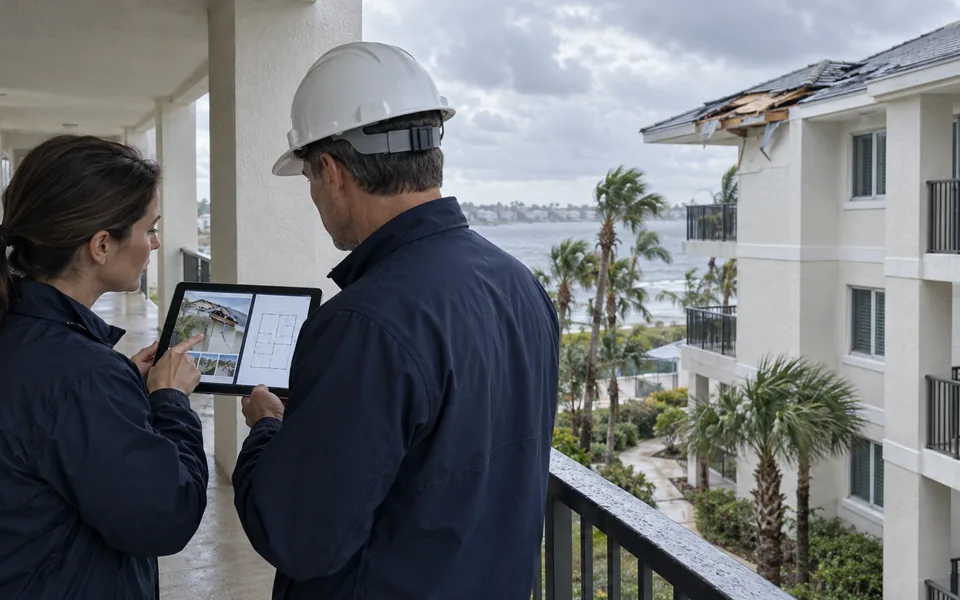
Identify the building, floor, room or asset, observed condition, date, source, and access limitations. Preserve original photos and distinguish a pre-loss baseline from a post-loss observation.
Track stabilization, access restrictions, inspections, temporary repairs, and vendor instructions. The record should show who made the decision and why the action was time sensitive.
Connect estimates, approvals, work descriptions, invoices, receipts, payments, and any scope changes. Separate emergency stabilization from permanent repair and from unrelated maintenance.
Keep notices, adjuster visits, document requests, submissions, responses, and the current open-item list together. Record what was provided and when, rather than relying on email history alone.
Capture board authority, vendor selection, resident impact, funding, unresolved questions, and final acceptance. A claim file must remain understandable after the people managing it change.
Do not edit an original image to make damage appear clearer. Store an annotated copy separately and retain the original. Use a stable naming convention that includes location and date, plus a short log describing who captured the file.
A coastal event may affect common elements, individual units, contents, equipment, and business or service continuity in different ways. The association should not assume that one policy, deductible, or claim process answers every question. Record the potentially affected interests and let the insurer and qualified advisers determine the relevant coverage and responsibilities.
Maintain a current list of affected areas and access restrictions for residents and vendors, while limiting personal and unit-level details to authorized recipients. Give residents verified status and the next update time; avoid promising a repair completion date that depends on an inspection, funding decision, or material availability.
When the initial estimate changes, preserve the previous version and document the new observation, changed scope, cost effect, and approval path. The change order register and closeout checklist are useful once repair work becomes a controlled project.
Use these 24 checks to keep safety, notice, conditions, photographs, expenses, correspondence, board decisions, and closeout in one traceable record.
Download the CSV checklist to assign an owner, add dates, and record the evidence for your property.
24 checks shown
No check matches those filters. Try a different term or area.
| Review area | Check | Evidence to request | Decision question |
|---|---|---|---|
| Safety | Site access | Qualified safety direction restricted areas and authorization | Can documentation proceed without exposing people? |
| Safety | Immediate protection | Temporary measures decision owner and work record | What must be done to prevent further damage? |
| Notice | Insurer contact | Policy contact date of notice and claim reference | Has the loss been reported through the correct channel? |
| Notice | Policy inventory | Property flood wind equipment and other applicable policies | Which insurer or adviser should be consulted? |
| Notice | Deadline register | Policy conditions and current specialist advice | What time-sensitive requirement needs confirmation? |
| Baseline | Pre-loss condition | Dated photos inspections work orders and asset records | What evidence shows the condition before the event? |
| Baseline | Asset inventory | Location model age ownership and maintenance record | Which damaged item can be identified precisely? |
| Damage | Location map | Building floor unit common area and asset identifier | Can every observation be found again? |
| Damage | Photo log | Original image timestamp viewpoint and description | Is the image tied to a specific condition? |
| Damage | Inspection record | Qualified assessment findings and limitations | What remains unsafe or unverified? |
| Damage | Cause uncertainty | Observed facts separate from possible causes | What conclusion requires a specialist? |
| Preservation | Original files | Unedited originals secure copy and access log | Can evidence be reproduced without alteration? |
| Preservation | Removed material | Photos inventory storage or disposal reason | What can the adjuster still inspect? |
| Cost | Emergency expense | Authorization vendor invoice receipt and work description | Which cost was necessary to stabilize the property? |
| Cost | Repair estimate | Scope quantities assumptions and exclusions | Are competing estimates describing the same work? |
| Cost | Change record | Newly discovered damage and revised scope | What changed after the first estimate? |
| Coordination | Adjuster requests | Request date documents supplied and response due | What information is still outstanding? |
| Coordination | Vendor access | Inspection appointments escorts and site constraints | Who controls access to the damaged area? |
| Coordination | Board decisions | Approval record spending limit and reporting cadence | What direction can management act on? |
| Communication | Resident update | Verified status restrictions and next update time | What can be communicated without speculation? |
| Communication | Private information | Unit and resident details limited to authorized recipients | Is sensitive material being shared appropriately? |
| Reconciliation | Payment ledger | Advance partial final payment and related cost | How does each payment map to documented work? |
| Reconciliation | Open items | Disputed scope missing evidence and assigned owner | What remains unresolved and why? |
| Closeout | Final record | Accepted scope completed work warranty and retained evidence | Can the property explain the outcome later? |
The Florida Department of Financial Services hurricane recovery guidance advises prompt reporting and documentation with photographs, videos, and receipts. Its disaster insurance FAQ discusses temporary repairs and preserving damaged items. For a flood policy, consult the applicable FEMA NFIP claims manual and the actual policy. These sources do not replace the instructions and deadlines for this property’s coverage.
Safety and further-damage prevention come first. Photograph and inventory material before necessary removal when safe, retain what can reasonably be inspected, and follow the insurer’s instructions about disposal and inspection.
The insurer determines its coverage position under the policy, with qualified advisers available to help the association understand disputed or complex questions. The property team should document conditions and decisions without presenting an unverified coverage conclusion as fact.
Record the new location and observation, obtain appropriate inspection, preserve the prior estimate, and notify the relevant claim contact. Keep the changed work and cost separate until the review and approval path is clear.
After repair acceptance, cost reconciliation, open claim questions, warranties, and operational handover are addressed. Retain the file under the association’s records policy and any applicable professional guidance.